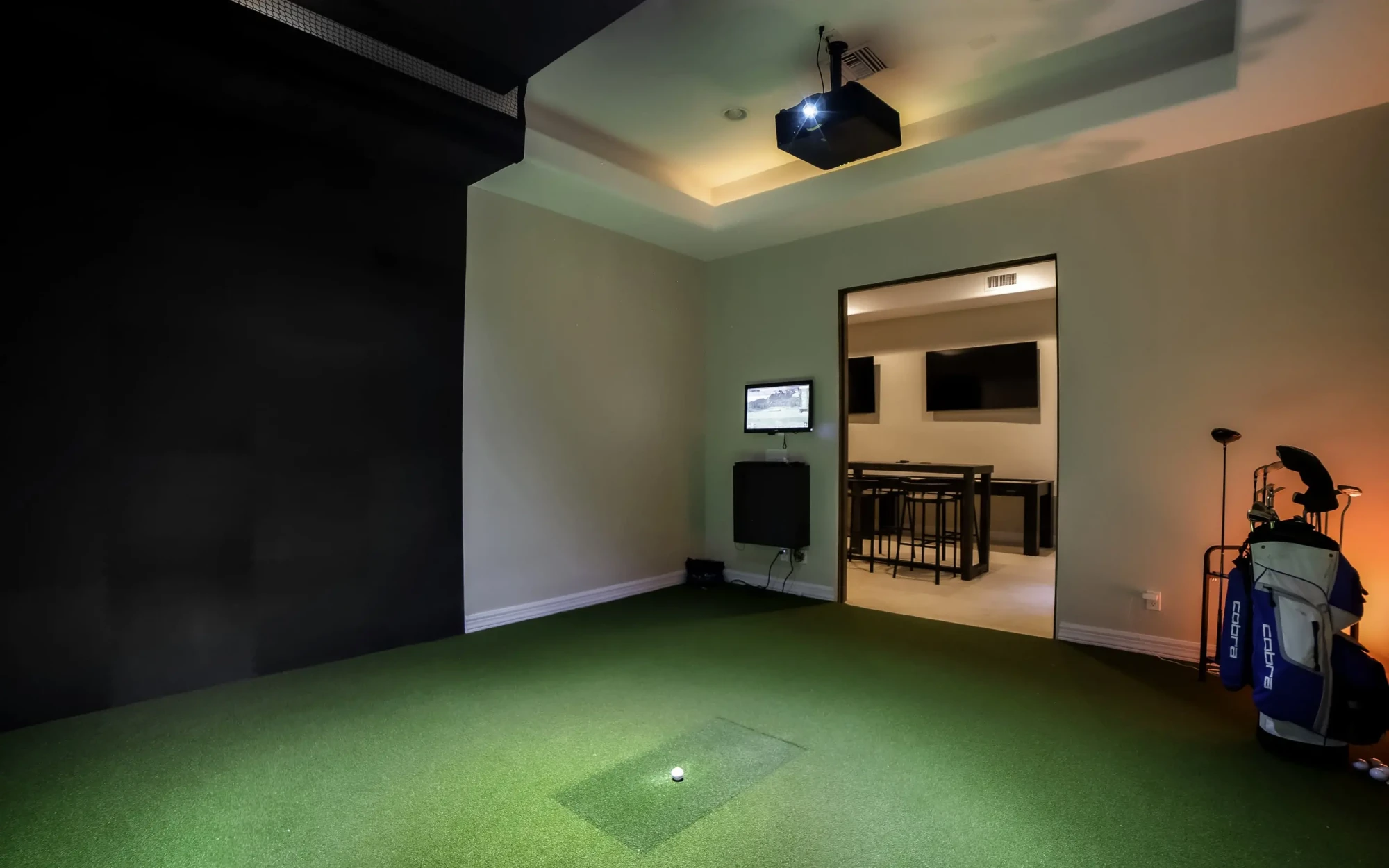
Golf simulators are expensive because the launch monitor alone accounts for the majority of the price. You're paying for high-speed cameras, Doppler radar, and specialized processors that track a ball at 150+ mph and measure spin to fractions of a degree. Then stack on impact screens, enclosures, projectors, software subscriptions, and room renovations. It adds up fast, and each layer has its own cost drivers worth understanding.
Strip away the enclosure, the screen, the mat, and the projector, and one component still eats most of your budget: the launch monitor. If you want an accurate system, your looking at spending $15,000 to over $30,000.
What drives it? Data. Budget units give you ball speed, carry distance, maybe smash factor. Spend more and you release club data, spin metrics, simulator compatibility with platforms like GSPro, and software tools built for serious practice. Premium models add commercial-grade durability on top. You're not just paying for better numbers you're paying for a more complete experience. Every single time.
Because these systems need to capture a golf ball moving at 150+ mph and measure spin rates, launch angles, and club path down to fractions of a degree, the hardware inside them isn't cheap consumer-grade stuff. We're talking high-speed cameras, infrared sensors, and Doppler radar basically industrial measurement tools disguised as golf gadgets.
And it's never just one sensor. Premium units stack multiple cameras and tracking modules together for overlapping measurements. Each one needs its own housing, wiring, and precise calibration. That bill of materials adds up fast. The technology split matters too radar-based systems like TrackMan and FlightScope dominate the high end, while camera-based options like Uneekor offer more value for home users, which is why radar-based systems cost significantly more.
Then there's the processing side. These systems crunch ball-flight data in real time, which demands specialized processors and imaging chips you won't find in your phone. The faster and more accurate the system, the more expensive the engineering behind it. No shortcuts here. The most advanced launch monitors on the market capture an extensive range of data points and can cost over $30,000 alone.
Some software can be purchased outright, but that's becoming rarer. Subscription models spread the pain but cost more long-term. Perpetual licenses sound better until you realize paid upgrades hit later anyway. Then there's compatibility: certain software only works with specific hardware, which kills your cheaper alternatives fast. Feature-rich packages with realistic graphics and advanced stats tracking cost even more. GS Pro is a popular choice among home simulator owners, but you should still budget at least $250 per year for the subscription. Premium platforms like aboutGOLF bundle software that includes over 90 courses and games, which helps justify their higher price tags but still adds to the overall investment. The sticker price never tells the whole story. The recurring fees do.
Even after you've stomped through launch monitor costs and software subscriptions, there's the physical space itself. Your room has to fit the hitting area, screen distance, projector placement, and safe clearance simultaneously. Low ceilings? You're renovating or relocating. Tight space? You're compromising on enclosure size, which means compromising on safety. Bigger rooms need more frame material, more screen area, more padding. Every extra square foot costs you. The room isn't just housing the simulator it is part of the simulator.
When people see a $30,000 to $60,000 price tag on a golf simulator, they assume it's the launch monitor doing all the damage and while that's the single biggest line item, it's not the whole story. You're paying for total realism every piece working together to make your brain forget you're indoors.
That means premium software ($500–$5,000), a high-resolution projector, a proper impact screen, a floor that doesn't destroy your joints, and a room that looks like a golf simulator. That's the gap. Each component nudges the experience closer to standing on an actual fairway, and every nudge costs real money. Realism isn't one expense; it's twenty. But if you want the most realistic golf simulator, then this is the only way.
You're paying for precision engineering, licensed course data, ande each component nudges the experience closer to standing on an actual fairway, and every nudge costs real money. Realism isn't one expense; it's twenty. But if you want the most realistic golf simulator, then this is the only way.
Don’t want to deal with all of this? This is where we come in. With over 20 years in the business, our expert team will help you create the golf simulator of your dreams. Contact us today or call any time at (602) 888-4018.