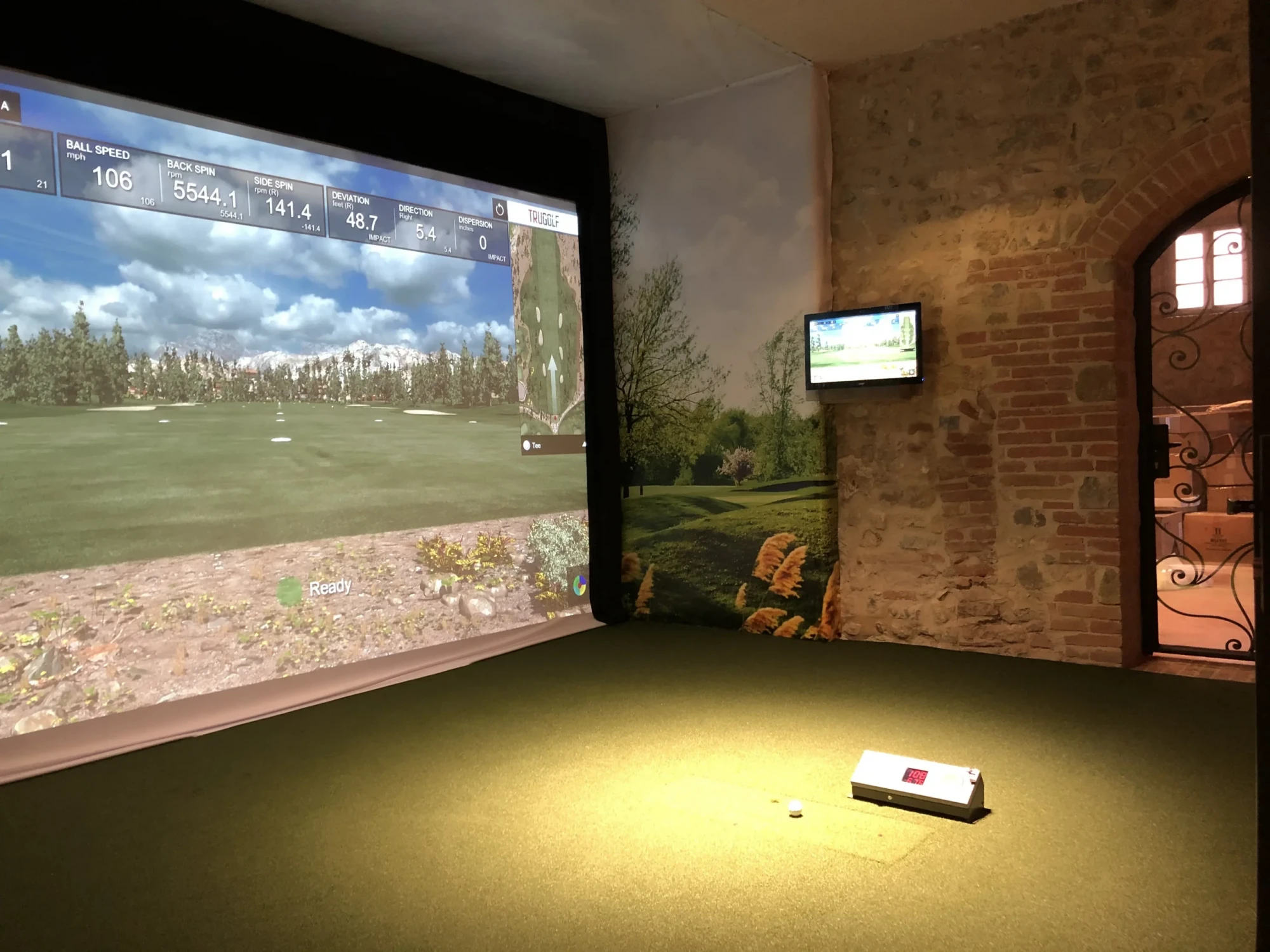
Unlike most launch monitors that sit on the floor behind you, the Apogee bolts to your ceiling and reads your shot from directly above. That means nothing sits in your swing path, and your floor stays clear. It's a cleaner bay, period.
But there's a catch: TruGolf requires 9 to 10 feet from your hitting surface to the unit. Not 8'6". Not 11 feet. Outside that range, you're out of luck, so measure before you buy.
The mount goes roughly 21 to 25 inches in front of your tee center, on a flat, level ceiling. You'll need a ladder, tape measure, laser level, stud finder, drill, and a plumb bob to drop your floor mark up to the ceiling. TruGolf also recommends about 14 feet of clearance around your swing, so factor that into your bay layout before drilling.
Then the Apogee projects a laser tee box. Nice touch. The automatic Laser Indicator also signals the moment the system is ready for your next shot.
Once the ball leaves the face, the Apogee's stereoscopic high-speed cameras grab nine data points on every single swing: five on the ball, four on the club. Ball side: ball speed, backspin, sidespin, vertical launch angle, and horizontal launch direction. Club side: club head speed, angle of attack, club face angle, and club path. That's it. No padding. TruGolf's Instant Impact algorithms read both the ball and the club at impact, so nothing is reverse-engineered from downrange flight.
And no, carry distance and total distance don't count. Those are calculated outputs, not measurements, so ignore any listing that pretends otherwise. TruGolf's marketing also throws around "25 professional-grade data metrics" for the wider platform, which is technically true and practically useless when you're comparing units.
One honest caveat: face angle can get fussy. One retailer admits you may need good lighting or a metallic sticker for best accuracy. Credit where it's due, though: the Apogee's camera-based vision tracking measures ball and club data directly, with no specialty balls or marked clubs required.
All that club and ball data means squat without software to play on, and this is where Apogee quietly wins. TruGolf pairs it with E6 Connect, and the Apogee-specific Home license requires no annual subscription. You own it. Twenty-seven courses, plus Stroke, Scramble, Best Ball, Stableford, Closest to the Pin, Long Drive, and in-round practice. That's real play, not a demo. Underneath it all sits an advanced physics engine refined over 30 years, which is why the ball behaves the way your swing says it should.
Want more? TruGolf sells an Expanded Subscription in its bundles; industry chatter puts Basic near $300 a year and Expanded around $600, with premium courses extra. The standalone Home license itself carries a regular price of $1,000 USD per license, with your product key delivered by email. Your call.
Setup's simple too. E6 supports 19 launch monitors, Apogee included, so you pick your hardware in E6 Golf 2026, update firmware, and swing. No third-party duct tape required.
So where does $7,995 actually land you? Squarely in premium territory, but not flagship-stupid territory. Foresight's GC3 runs about $6,999, so yes, you're paying roughly a grand more, though GC3 bundles climb to $8,999, which flips that math fast. Bushnell's Launch Pro starts at $2,499 to $3,499 and looks like a steal until you hit the $199 to $499 annual subscriptions. Three or four years in, that gap shrinks. Run it out five years on the Gold tier and the Launch Pro totals roughly $4,994, landing within $255 of the GC3's $5,249 price that already includes FSX Play and 25 courses forever. Worth noting, though, is that lifetime FSX Play only covers the base system, and running GSPro on a GC3 still means a separate $250/yr subscription. And the GCQuad? $14,500 to $15,999, with four cameras and club data most of us can't actually use. Reviews keep saying those gains are real but marginal for average golfers.
Price only matters if the thing actually works in your space, and that's where the Apogee gets picky. You need 9 10 feet of ceiling above the hitting surface, and the unit mounts 21 25 inches in front of the tee. No wiggle room there. The unit weighs around 22 pounds, so it needs a ceiling that can support a fixed mount. You're also drilling into your ceiling, so renters and anyone who wants a portable monitor should walk away now.
Who it's perfect for: you're building a dedicated indoor room, you hate tripping over floor sensors, and your house has both righties and lefties. The laser-projected 8"x10" tee box marks out a hitting area wide enough that either stance works without anyone touching the mount. Markerless tracking means no stickers, no special balls. E6 software is included.
Who it's not for: GSPro loyalists, since listings note E6-only compatibility. Sun-drenched rooms too; you'll be hanging curtains to keep the overhead cameras happy.
So, underrated? Yeah, absolutely. The Apogee doesn't get the hype TrackMan or Full Swing does, but at $7,995 with overhead cameras, no ball markings, and E6 Connect bundled in, you're getting a lot of simulator for the money. It's not perfect you need ceiling height and a real room, and it's not going anywhere once installed. But if you're building a dedicated bay, stop overlooking this thing. Just buy it.
Don’t want to deal with all of this? This is where we come in. With over 20 years in the business, our expert team will help you create the golf simulator of your dreams. Contact us today or call any time at (602) 888-4018.