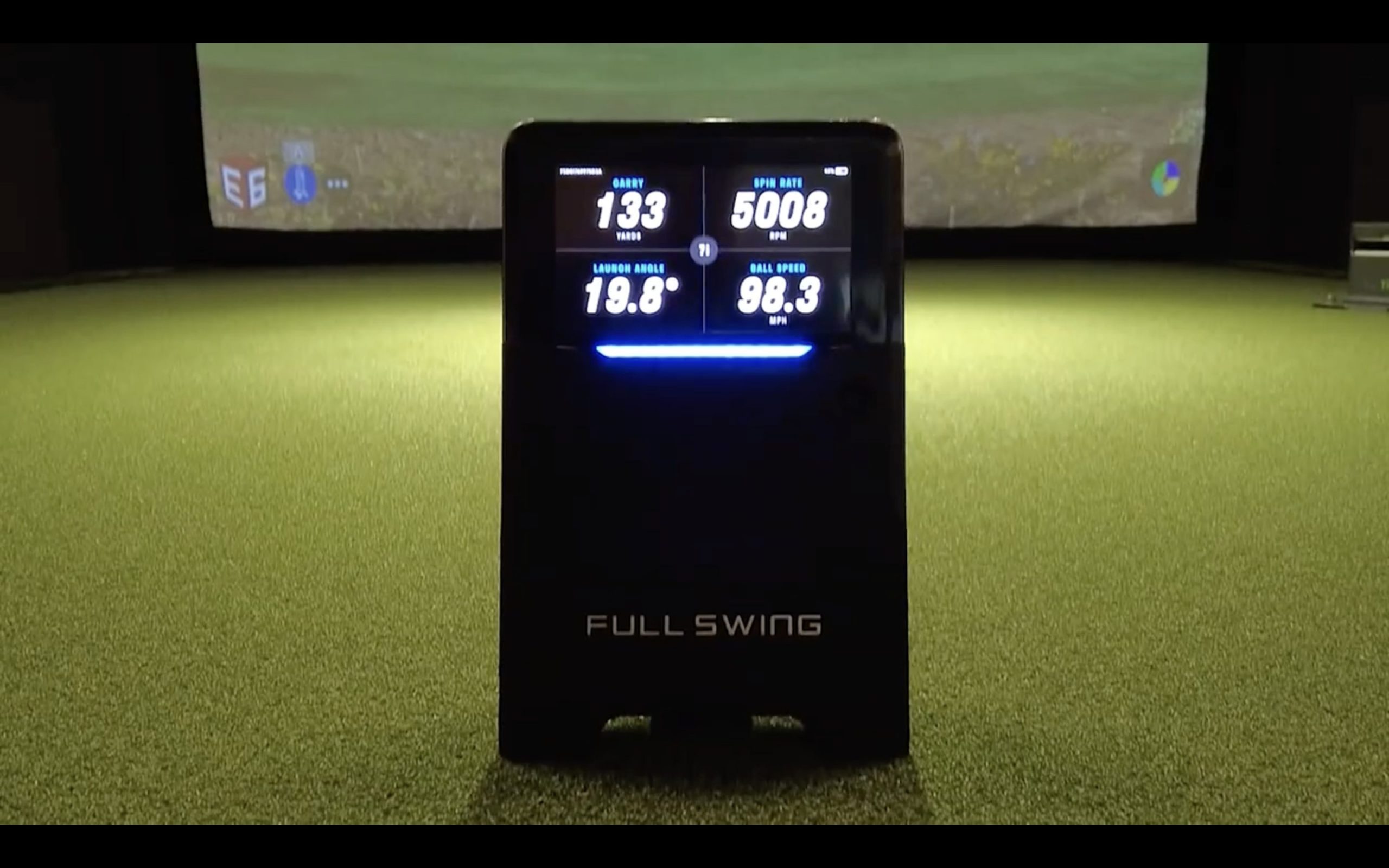
Before you start bolting together a hitting bay, take a hard look at what the KIT actually is: a 4-pound portable box, roughly 10.2 inches tall, 6.6 wide, and 2.3 deep, about 3.7 with the support leg kicked out. On the front of that box is a 5.3" Ultra-bright Full HD OLED display, paired with a patented 24GHz dual-mode radar and a 1080p camera shooting at 60 fps. It ships with a travel case, charging block, USB-C cable, and a quick start guide. That's it.
Inside sits an 8000mAh lithium-ion battery, good for about five hours, recharging in roughly two hours via USB-C. You can't swap it. When it dies, you're done until it charges.
The KIT measures 16 club and ball numbers on every swing, and none are behind an unlock fee. No paywall, no "premium tier." Fresh, honestly.
Think of them in three buckets. Ball flight: carry distance, total distance, ball speed, launch angle, spin rate, spin axis. Club delivery: club speed, smash factor, attack angle, club path, face angle, face-to-path. Direction and dispersion: horizontal angle, apex height, side carry, side total. Worth noting on that spin number: the KIT's integrated 4K camera measures actual spin instead of estimating it from ball flight, which is the accuracy edge radar-only units don't have.
That covers both questions you actually care about: how far it went and why it curved. Full Swing's materials list these 16, and independent reviews repeat the same set. So you know what you're buying. Better still, you can read them in real time off the 5.3" OLED display without ever pairing a phone.
While the marketing loves to blur this line, let's be clear: the KIT is a launch monitor. It measures your shots and records video. That's it. It doesn't hand you a virtual golf course, and the native app leans toward practice, swing video, and shot analysis rather than immersive play. To its credit, it does that measuring job thoroughly, capturing 16 metrics including spin rate and spin axis according to Full Swing's published specifications.
Want to actually play golf indoors? You'll need third-party software like E6 Connect or GSPro, plus a computer, projector, screen, and enclosure. Yes, Full Swing throws in a 5-course mobile E6 license, but that's a demo, not a simulator package. Expanded course play means more purchases or subscriptions.
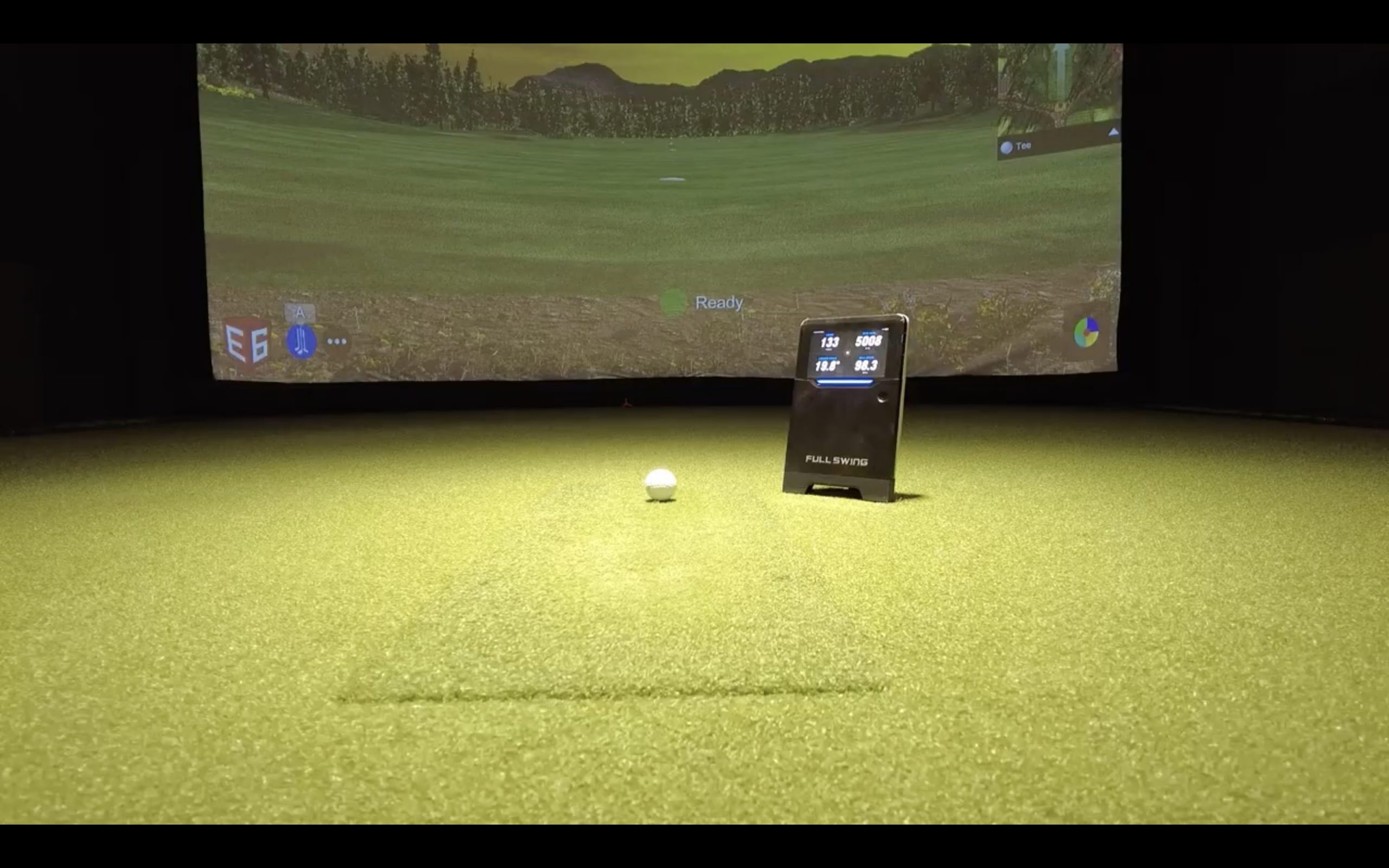
That's about 18 to 20 feet of usable depth, and some setup guides push for 21 feet to give you real buffer.
Here's the simple math: 8 to 10 feet behind the ball, 8 to 10 feet from the ball to the screen or net. You'll want a 9-foot ceiling and at least 10 feet of width, 12 to 14 if you're running a full enclosure. A few listings claim 16 feet works. Sure, technically.
The KIT is 10.23 inches tall and weighs 5.7 pounds, so it fits anywhere. That's not the point. It's radar, which means it needs ball flight to read launch data before the ball hits your screen. Cramp that, and you get sketchy numbers. Worth knowing: Full Swing publishes no minimum ceiling height for the KIT; it's the radar placement that dictates how much room depth you actually need.
Set it level, square to your hitting line, and keep it the same distance every time. Calibration wants the ball sitting 10 ft in front of the KIT, and shifting it off to the side costs you accuracy.
Once you crack open the box, you get the launch monitor, a charging block, a USB-C cable, and a protective travel case. That's it. Full Swing's marketing states, "No extra accessory fees here, it's all included," which is technically true and practically useless, because the four things included are the four things you'd expect. At around $5,000, that price buys you the radar unit and the hardware needed to keep its five-hour lithium-ion battery topped off nothing that turns a room into a simulator.
No enclosure. No impact screen. No hitting mat, no turf, no landing pad. No projector, no ceiling or floor mount, no HDMI cable. No side netting, no sandbags, no frame padding. Full Swing's own KIT Studio pages pair the monitor with a 10- or 12-foot enclosure because those are add-ons you buy.
Bottom line: the KIT is a decent launch monitor. It's not a simulator. Budget the $5,000 for the KIT, then add a projector, impact screen, enclosure, hitting mat, and an iPad or PC that can actually run the software. You're looking at $15,000 to $25,000 before you hit a single ball. Know that going in, plan your space and your ceiling height, and you'll love it.
Don’t want to deal with all of this? This is where we come in. With over 20 years in the business, our expert team will help you create the golf simulator of your dreams. Contact us today or call any time at (602) 888-4018.