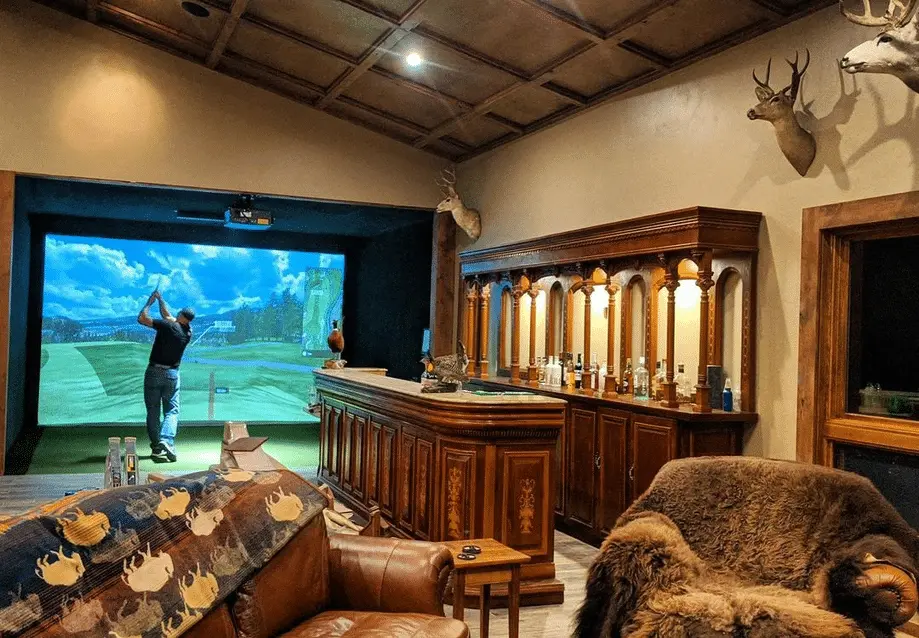
Golf simulators are absolutely worth it for dialing in your full swing, premium systems nail ball speed and launch angle within 1–3% of outdoor monitors, and you'll crank out way more reps in a 30-minute session than you'd get on any range. But here's the catch: they'll flatter your score by 5–10 strokes because flat mats, auto-putts, and zero wind don't exist in real life. The real magic is knowing how to use both together.
Before you drop thousands on an indoor setup, you need to know what you're actually getting because the marketing will have you believing a simulator is basically a teleportation device to Augusta.
Premium systems using camera-based photometric or radar Doppler tracking measure ball speed, launch angle, and spin rate within a few percentage points of outdoor monitors. Full-swing shots are where simulators shine, with roughly 1–3% deviation from real-world results when everything's properly calibrated. Systems that combine photometric and radar methods deliver the broadest accuracy across both full swing and short game scenarios.
Remember. Misalign your setup or skip calibration, and you'll get garbage data dressed up in pretty graphics. Other common accuracy killers include inadequate lighting, worn or incorrect balls, and improper mats all factors that degrade reliability if left unchecked.
The real weak spot? Putting and short game. No simulator honestly replicates green friction, grain, or surface imperfections. They're approximations at best.
Although your simulator might tell you you're shooting in the low 80s, don't update your handicap just yet because those scores are lying to you by a solid 5–10 strokes, sometimes more. The biggest culprit? Putting. Most simulators use auto-putt or gimme circles that basically hand you free strokes. That alone can shave 10 shots off your round.
Then there's the fact that you're hitting every shot from a perfectly flat mat. No sidehill lies, no thick rough, no wind gusting at 15 mph mid-backswing. You're also setting up dead square to a screen line every single time alignment that's practically impossible outdoors. Some players report simulator handicaps around 10–20 while actually playing closer to 30 on real courses. That's not improvement. That's a fantasy. Ironically, higher-end simulators actually let you practice uneven lies, punch shots, and bump-and-run chips, which means the gap between sim and real scores often comes down to whether your setup can simulate on-course situations or just serves up perfectly flat reps. The smartest approach is to treat your simulator as a training environment where you build repeatable skills, especially wedge distances and club gapping and then track your handicap on actual courses to see whether that work is producing real improvement.
Then there's the short game. Chipping with a score on the line feels completely different than flipping wedges on a practice green. Your brain logs those pressure moments.
Green reading is another thing simulators basically fake. Real putts break left, right, uphill, downhill, sometimes all at once. Grain matters. Speed changes with slope. You can't learn that indoors.
Real golf also demands emotional control. Every shot counts. Walking the course covers approximately 4–5 miles, so beyond the mental game, you're also getting low-impact physical activity that a simulator simply can't replicate. That's irreplaceable. You're also navigating real hazards, including lightning risk, which forces awareness and decision-making no indoor setup can simulate.
All of that matters real golf teaches things a screen simply can't. But simulators genuinely crush course play in several areas.
Weather doesn't exist indoors. Rain, snow, 100-degree heat none of it touches you. You play when you want, not when the forecast allows it. That alone keeps your swing sharp year-round instead of rusting for months. Controlled environments ensure consistent conditions so every session is measured against the same standard, letting skill and decision-making shine through.
Repetition is faster too. Hit, get data, hit again. No walking to your ball, no waiting on slow foursomes. Launch monitors give you club speed, launch angle, and shot shape instantly feedback that'd cost you a lesson on the range. You can even jump into online competitive tournaments against players worldwide, adding real pressure and stakes that pure range sessions never deliver.
And convenience? A 30-minute focused session at home beats a five-hour round when you're working on swing changes. More reps, less wasted time. Period.
Owning a simulator doesn't mean you stop playing real golf it means you show up to the course with better data and fewer question marks. Use indoor sessions to dial in carry distances for every club, test tee-shot accuracy patterns, and rehearse course management from specific yardages. Then take those numbers outside and see what actually holds up when wind, elevation, and real turf enter the equation.
A solid routine: build your distance chart indoors at 25-yard intervals, practice proximity targets at 50, 100, and 150 yards, then play a real round as your performance test. The simulator handles the reps. The course delivers the truth. When schedules or weather block tee times, online simulator rounds keep your group competitive between real outings.
Golf simulators won't replace real course play and anyone telling you otherwise is selling something. But they're a damn good training tool, especially if you're stuck in a cold climate or short on time. Pair simulator sessions with actual rounds and you'll improve faster than doing either alone. Just don't kid yourself that your simulator 68 means anything on Sunday morning.
Want to learn more about our custom residential and commercial golf simulators? With over 20 years in the business, our expert team will help you create the golf simulator of your dreams. Contact us today or call any time at (602) 888-4018.