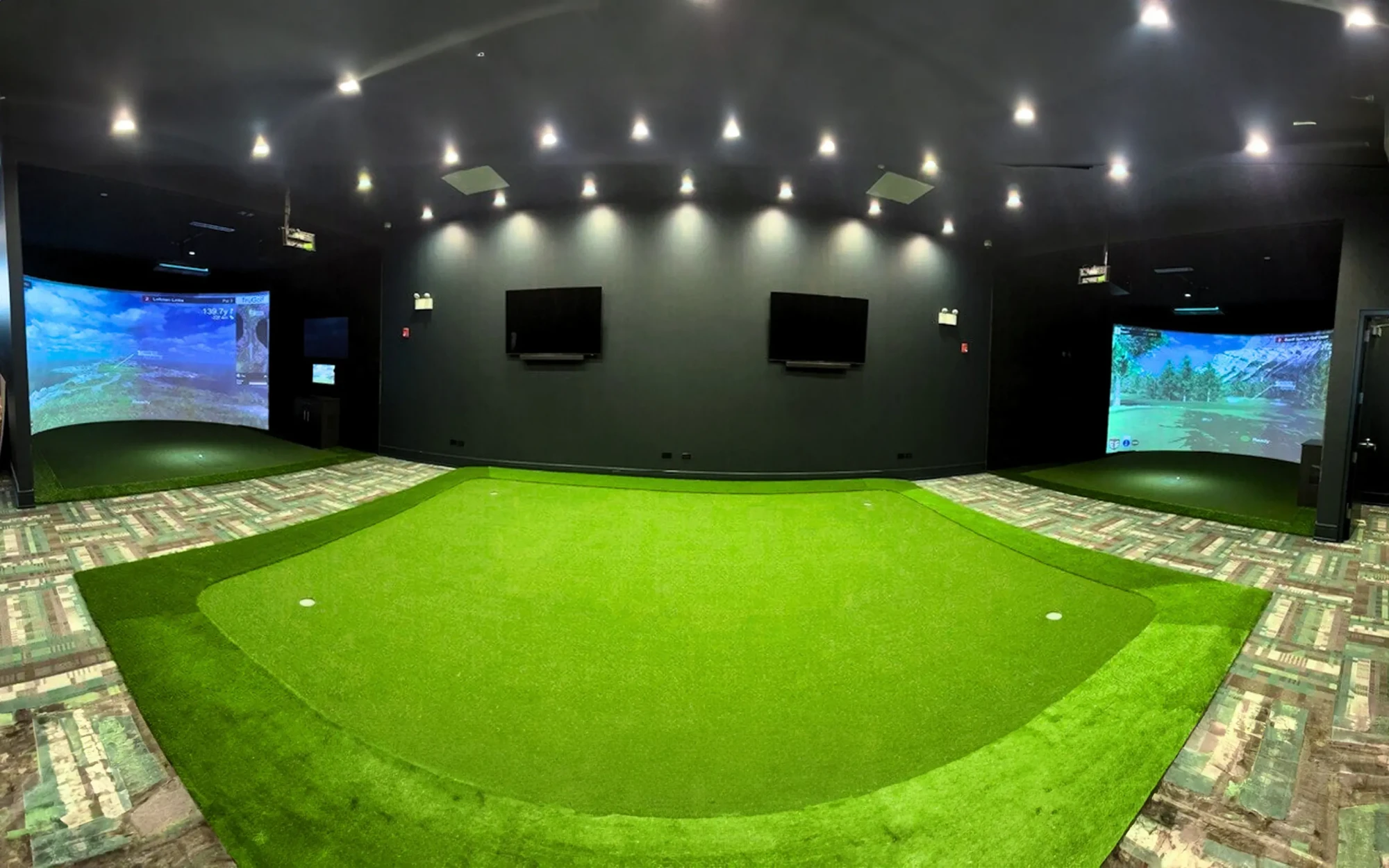
A launch monitor measures your shot data ball speed, spin rate, launch angle while a golf simulator combines that data with a screen, projector, enclosure, and software to let you actually play virtual courses. Think of the launch monitor as the engine and the simulator as the whole car, so understanding the difference before you buy saves real money, and we'll break down exactly how below.
A launch monitor measures your shot. That's it. It tracks ball speed, spin, launch angle the raw numbers that tell you what actually happened. A golf simulator takes that same data and builds a whole experience around it: screen, projector, enclosure, software, virtual courses. You're playing Pebble Beach in your garage.
Think of it this way. The launch monitor is the engine. The simulator is the entire car. The simulator uses your swing data to predict ball trajectory and project it onto a virtual green, giving you the full visual experience of watching your shot play out. It also renders penalties, weather, and scenery, creating narrative around technical data.
Every decent simulator has a launch monitor inside it, but you don't need a simulator to use a launch monitor. You can take one to the range, set it on the grass, and get immediate feedback on every swing. Analysis vs. experience that's the real split.
Launch monitors track a frankly absurd amount of data, and that's a good thing. You're getting ball speed, launch angle, spin rate, carry distance, and total distance on the ball-flight side. Then there's club delivery stuff: clubhead speed, club path, face angle, angle of attack, and smash factor.
But it goes deeper. Good units measure impact location on the face, real-time loft, apex height, descent angle, and your dispersion pattern across multiple shots. That last one's huge; it shows you where your misses actually go, not just where your best shots land. All of this data lets you make informed adjustments to your swing mechanics, ball position, and club selection rather than relying on feel alone.
How they capture all this varies. Radar-based systems track the ball in flight. Camera-based systems use high-speed images at impact. Some advanced units combine both for the full picture. Accurately measuring spin is one of the trickiest parts. Camera systems, for example, can analyze the dimple pattern rotation across hundreds of images to determine precise spin rate and spin axis.
When people ask whether simulator numbers actually match what happens on a real course, the honest answer is: surprisingly close, but not perfect. Premium systems like Trackman and GCQuad nail ball speed and carry distance within 1–3% of outdoor results. That's a 150-yard shot reading 148–152 indoors. Pretty good.
Where things get shaky is everything after the ball lands. Roll, total distance, and ground interaction? Those depend on conditions no simulator can fully replicate: firmness, humidity, actual turf. Wind's obviously missing too. Environmental variables like temperature, humidity, and elevation can shift shot distance by up to 30–40 yards with longer clubs, which is a gap simulators have to approximate through software settings.
Don't obsess over matching every single yard to your course game. Use simulator data for tracking trends ball speed changes, spin consistency, and launch angle patterns. That's where the real practice value lives. The best systems use physics-based projection models that account for spin decay, air resistance, and gravity to recreate realistic ball flight from the data captured at impact.
Every launch monitor falls into one of three technology camps radar, camera (photometric), or overhead camera and each one sees your shot in a fundamentally different way. Radar tracks the ball through space using radio waves great outdoors, but it needs 15–19+ feet of room depth indoors. That kills most garage builds. Camera systems like Foresight's GCQuad use high-speed cameras to capture the ball within the initial part of flight, then model the rest with physics algorithms. Way less depth required. These camera systems also excel at capturing club data at impact, such as face angle and attack angle, making them a top choice for club fitting and swing analysis. Overhead camera systems mount above your hitting area, keeping the floor clear ideal for tight simulator bays if your ceiling height cooperates. Camera-based platforms like Uneekor deliver weather-proof performance across indoor studios, hybrid bays, and covered coaching spaces where radar would struggle for consistency.
You don't need both you need the right one. If you just want data to improve your swing, a launch monitor is great, but if you want to play Pebble Beach in your basement in January, you're building a simulator. Know what you actually need before you spend. That's it. Don't overthink this.
Want to learn more about our custom residential and commercial golf simulators? With over 20 years in the business, our expert team will help you create the golf simulator of your dreams. Contact us today or call any time at (602) 888-4018.