Yes, golf simulators genuinely help your game but they're not a replacement for real turf under your feet. They're fantastic for dialing in swing mechanics, building a reliable wedge matrix, and exposing miss patterns through hard data like club path and spin rate. Where they fall short: no wind, no uneven lies, and zero pressure that mimics a real four-footer. The key is knowing exactly which skills transfer and which don't.
If you've been wondering whether dropping money on a golf simulator is actually going to lower your scores, the short answer is yes but with a pretty big asterisk. Simulators genuinely improve specific parts of your game. Swing mechanics, club speed, ball-striking consistency, shot strategy all get better with regular indoor practice. The data feedback alone is worth it. You'll spot tendencies in your swing path and spin rates that you'd never catch on the range.
But here's what they won't do: replicate real golf. No wind. No weird lies. No pressure of standing over a four-footer with your buddy watching. Simulators are a killer training tool, not a replacement for actual course play. Treat them accordingly and you'll see real improvement. Since you can practice regardless of weather or time constraints, simulators also let you maintain year-round training consistency that would be impossible if you relied solely on outdoor sessions. The best part is that immediate feedback enables you to quickly identify and correct swing errors, so every session builds on the last instead of reinforcing bad habits.
So which parts of your game actually get better? Five specific skills stand out.
Distance control. Testing 40, 60, and 80-yard wedge shots repeatedly builds a real wedge matrix you can trust.
Approach precision. Hitting 100–180 yard targets and tracking how often you land within 20 feet gives you honest feedback.
Driving accuracy. Narrow fairway targets plus dispersion data expose your miss patterns fast.
Shot-shape control. You can practice low punches, high fades, and knockdowns without needing wind or different turf. Launch angle and spin numbers show exactly what your swing produced.
Course strategy. Replaying tough holes lets you test layup decisions and hazard avoidance without burning a $80 green fee. Playing detailed recreations of iconic courses exposes you to doglegs, elevated greens, and water hazards that teach design-driven strategy you'd otherwise never encounter.
These five aren't random they're measurable, repeatable, and data-driven. Because simulators offer instant feedback after every shot club path, face angle, spin rate, strike location you can pinpoint exactly what changed and why.
Even though simulators nail the five skills we just covered, they quietly whiff on some stuff that matters a lot once you're standing on actual grass.
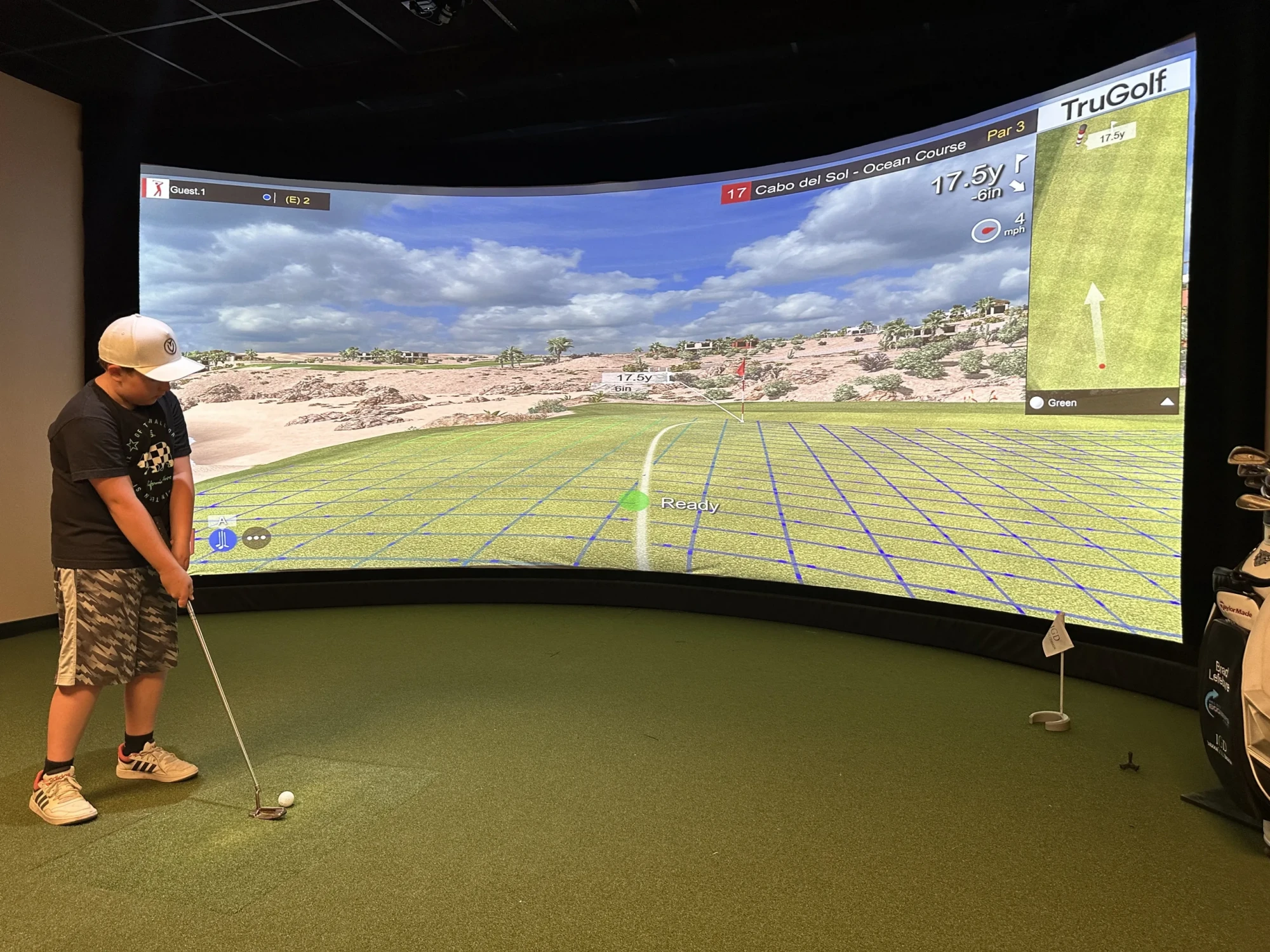
Short game feel is the biggest gap. You can groove a repeatable chipping motion indoors, but you're hitting off a flat mat every single time. No sidehill lies, no thick rough grabbing your wedge, no grain running against you. That's not practice; that's rehearsal.
Then there's pressure. Simulators don't care if you chunk it. Real golf does. You won't learn to protect against a short-sided miss when there's zero consequence for getting it wrong. That said, the pressure-free indoor setting does help beginners build a foundation of confidence before they ever face those real-world stakes.
Wind, uneven stances, wet turf, bunker texture simulators either guess at these or skip them entirely. Your numbers look clean indoors, then the course humbles you fast.
Most people step into a simulator and just start mashing driver like it's a home run derby. That's fun for about ten minutes, but it won't lower your scores.
Pick one goal per session. Seriously, just one carry distance, start line, whatever your biggest scoring leak is. Then stick with it.
Spend real time on wedges and partial shots. Half swings, three-quarter swings, dialing in those 85-yard and 115-yard numbers. That's where strokes actually disappear. Track your carry dispersion and see how tight you can cluster shots around a target. Without weather or seasonal interruptions, you can build consistent muscle memory faster than relying on outdoor range sessions alone.
Then add pressure. Simulate actual holes. Play virtual rounds on faithfully reproduced PGA Tour courses to practice the strategic decisions and tough pin placements you'd face in competition. Use a pre-shot routine every single swing. Log your results club, carry, miss direction so you're measuring progress instead of guessing. Data beats feelings every time.
Blocking out your week in advance is the difference between actually improving and just hitting balls whenever you feel like it. Two simulator sessions per week at 55 minutes each is plenty for most recreational golfers. Pick your days, book a bay, and stick to it.
Day one, hit the sim with one technical focus. Day two, play nine holes on a real course to see if your changes survive wind, uneven lies, and pressure. Day three, rest and review your notes. Day four, back on the sim targeting the same skill. Every four weeks, retest your carry and dispersion numbers so you can rebalance your focus based on real progress instead of guesswork.
Don't overcomplicate this. The simulator handles measurable, repeatable reps. The course handles decision-making and scoring. Use both for what they're actually good at instead of leaning on one alone. Before each session, review your previous notes so you maintain continuity between sessions rather than starting from scratch every time you walk in.
A golf simulator won't fix your short game or teach you to read a breaking putt full stop. But for dialing in carry distances, grooving a consistent swing, and building club-fitting data you'd never get at a range, it's genuinely useful. Treat it as one tool, not the whole toolbox. Blend simulator reps with real course time, and you'll actually see those scores drop.
Want to learn more about our custom residential and commercial golf simulators? With over 20 years in the business, our expert team will help you create the golf simulator of your dreams. Contact us today or call any time at (602) 888-4018.